In the pervious chapter we asked:
When data varies, what remains stable?
We answered:
A distribution describes how values are generated
The expectations gives the center
The variance gives the spread
However, we made one critical simplification:
We only looked at one variable at a time
The New Problem
Real data is almost never one-dimensional
instead, we observe multiple variables simultaneously:
weight and height
temperature and electricity demand
study time and exam score
price and demand
This raises a new question
If each variable has its own distribution, how do variables behave together?The core question of this chapter
When mulitple variables vary, what structure governs their relationship?
observing joint variation
First let’s start a simple example.
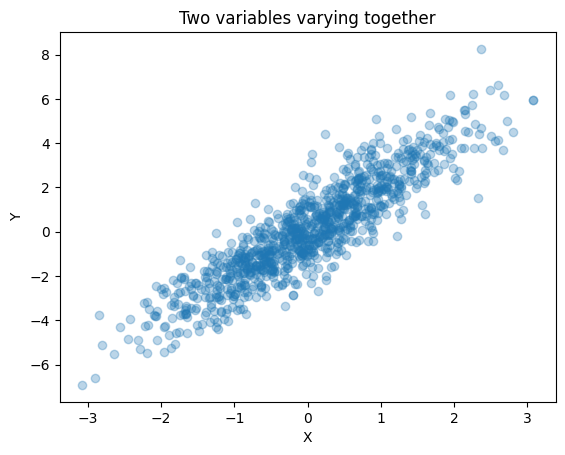
We observe:
x varies
y varies
but they are NOT INDEPENDENT There is a pattern.
Why mean and variance are NOT ENOUGHT
From Chapter8:
mean tells us where values center
variance tells us how much they spread
But now we have two variables,questions we can not answer using only mean and variance:
When x increase, does y increase?
Do they move together or independently?
How strong is their relationship?
This leads to a new concept:
We need a way to measure joint variation.Introducing Covariance
We define:
Covariance measures how two variables vary together
Intuition:
If x and y increase together -> positive covariance
If one increases while the other decreases -> negative covariance
If they move independently -> covariance near zero
print(np.cov(x,y))[[1.0645908 2.12158412]
[2.12158412 5.21164557]]
Conceptually:
Covariance measures whether deviations from the mean occur together.
If x is above its means and y is also above its mean -> positive contribution
If one is above and the other below -> negative contribution.
Key interpretation:
Positive convariance -> variables move together
Negative convariance -> variables move oppositely
Near zero -> no linear relationship
Why convariance alone is NOT ENOUGHT
Covariance depends on scale.
For example:
measuring height in cm vs meter changes covaiance
measuring income in dollars vs thousands changes covariance
This mankes raw covariance difficult to compare.
Correlation: A standardized measure
To address this, we normalize covariance.
Correlation is a scale-free measure of relationship
Properties:
range between -1 and 1
unit free
directly interpretable
np.corrcoef(x,y)array([[1. , 0.9007027],
[0.9007027, 1. ]])Interpretation:
+1 means perfect positive relationship
0 means no linear relationship
-1 means perfect negative relationship
Visual Interpretation of correlation
We can compare different relationships
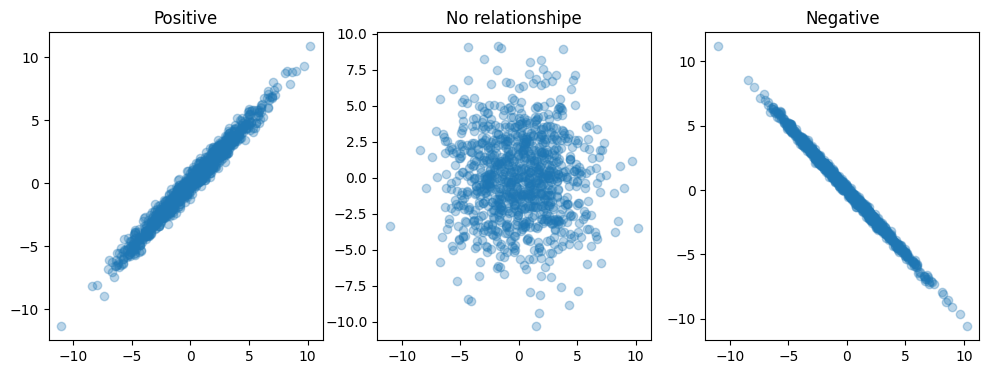
Observation:
correlation captures the direction and strength of linear relationship
From pairwise relationships to structure
So far, we have considered two variables,in real datasets, we often have many variables.
We can compute a covariance matrix
data = np.random.multivariate_normal(
    mean=[0, 0, 0],
    cov=[[1, 0.8, 0.5],
         [0.8, 1, 0.3],
         [0.5, 0.3, 1]],
    size=1000
)

np.cov(data.T)
array([[1.07101946, 0.87138028, 0.51823156],
[0.87138028, 1.07009019, 0.35387897],
[0.51823156, 0.35387897, 0.97318215]])This Matrix summarizes:
variance of each variable(diagonal)
covariance between variables(off diagonal)
Why this matters in Machine Learning
Many machine learning methods rely on relationshipe between variables. Example:
Linear regression: models how variables influence each other
PCA: finds directions of maximum covariance
Feature selection: removes redundant(heighly correlated) variables
This leads to broader insight:
Machine learning is not only about individual variables,
but abount the structure formed by their relationships.Summary
We return to the central question:
When multiple variables vary, what structure governs their relationship?
The answers is:
covariance describes how variable vary together
correlation provides a standardized measure of that relationship
the covariance matrix captures the overall structure
Statistics is not only about variation, but about structured variation.